The Veezoo Analytics Cup is live — Submit by May 25 and win a MacBook Pro
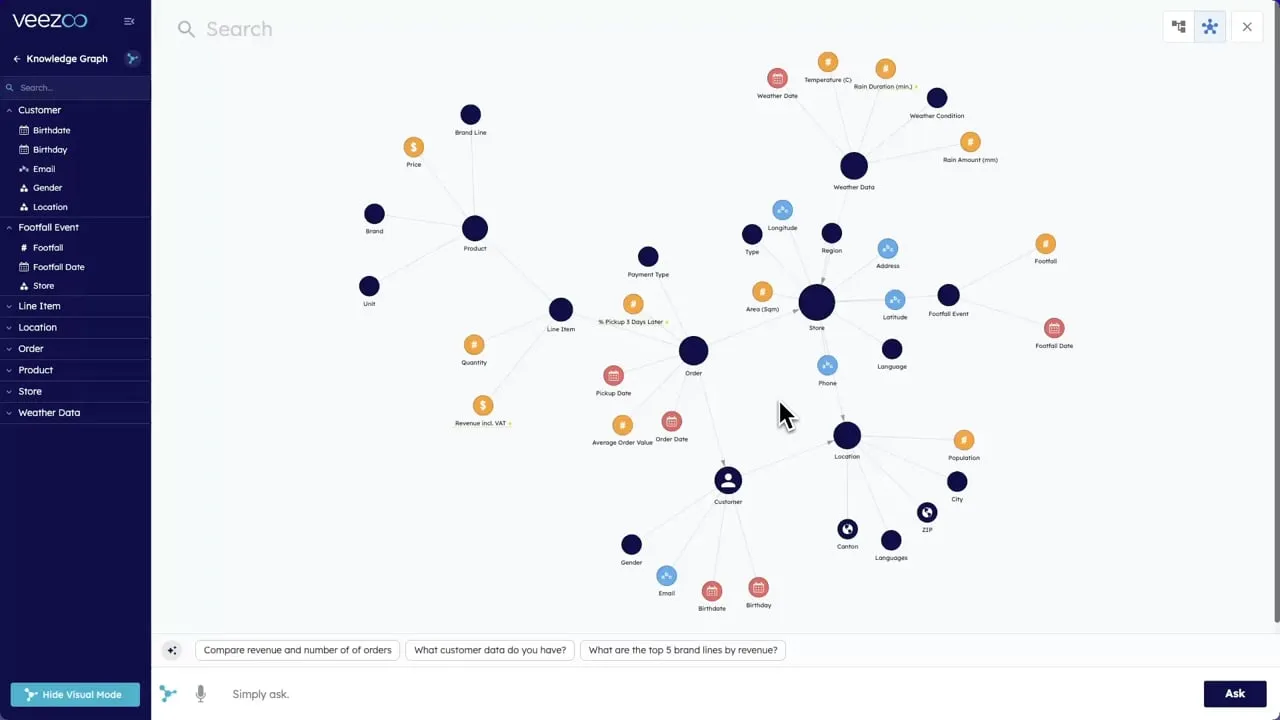
Veezoo Knowledge Graph semantic layer for AI BI

AI BI needs a semantic layer. Veezoo gives it one.

Language models cannot reliably guess what your business means by "revenue", "active customer", or "churn". Veezoo's Knowledge Graph is the semantic layer for AI BI: it defines concepts, metrics, synonyms, relationships, and permissions, and the AI reasons over those concepts, not raw tables. It writes a semantic query against the Knowledge Graph, which is then deterministically compiled to SQL.

Built for

Data teams building reliable AI BI

Analytics engineers standardizing business logic

Leaders evaluating governed conversational analytics

The semantic layer for AI BI, defined

A semantic layer for AI BI is a machine-readable map of your business, concepts, metrics, relationships, permissions, and rules. Veezoo's Knowledge Graph is purpose-built for this. The AI plans analyses over Knowledge Graph concepts, and a deterministic compiler translates the plan to SQL, so AI BI answers stay consistent with how your data team defines the business.

What it defines
Business concepts and hierarchies, metrics and KPIs, synonyms and descriptions, relationships, custom SQL, dynamic URLs, and permissions.
Why AI needs it
LLMs alone hallucinate column meanings and re-derive metrics inconsistently. A semantic layer anchors them to definitions your team owns.
How it's managed
Veezoo Studio IDE, VKL code in a Git-backed repo, branches, automated tests, version history, and AI-assisted improvements.
Output
Deterministic VQL → SQL compilation; every result is traceable from natural language down to executed SQL.
Reuse
The same definitions power chat, dashboards, alerts, scheduled business reviews, and embedded analytics.

Common buying questions answered here

  • semantic layer for AI BI
  • semantic modelling for AI BI
  • AI business intelligence semantic layer
  • business intelligence tool that avoids hallucinations

What a semantic layer for AI BI must capture

Six layers of structure that turn a warehouse into something AI can actually reason about.

Business concepts & hierarchies

Classes, subclasses, custom orders, and roll-ups: Employee as a subclass of Person, Region → Country → City, fiscal-year hierarchies.

Reusable metrics & KPIs

Measures defined once with precise calculation logic, usable in chat, dashboards, alerts, and embedded analytics without re-implementation.

Synonyms, descriptions, and ontologies

Governed synonyms for concepts and entity values plus rich descriptions that improve both AI grounding and human understanding.

Permissions and governance

Knowledge-Graph-level, column-level, and row-level access enforced before SQL is executed, so AI inherits the same controls as the warehouse.

Relationships, custom SQL, and UDFs

Multiple join types, custom SQL, UDFs, and views support star, snowflake, data vault, and mixed legacy models without a redesign.

Versioned as code

Defined in VKL, stored in a Git-backed repo, evolved through branches and automated tests, with one-click revert to any checkpoint.

Why AI BI needs a semantic layer, and how Veezoo provides one

Q1

Why does AI BI need a semantic layer?

Without one, the LLM has to guess what "revenue" means in your warehouse and which join produces the right result. Even when it gets it right once, the same question phrased differently can produce a different SQL query, and a different number.

A semantic layer fixes the definitions once. The AI plans against those definitions, and the SQL is generated by a deterministic compiler, not by the model. The result is AI BI that is auditable, governable, and consistent across surfaces.


Q2

What is semantic modelling?

Semantic modelling is the work of defining business concepts (Customer, Order, Region), metrics (Revenue, Churn Rate), relationships (Order → Customer), synonyms (Income = Revenue), hierarchies (Region → Country → City), governance rules, and reusable analytical building blocks.

In Veezoo, this lives in a VKL repository that data teams maintain like code. Studio provides a dedicated IDE, AI-assisted improvements, automated tests, and visual diffs.

Q3

How is Veezoo's Knowledge Graph different from a generic metrics layer?

A metrics layer typically standardizes a set of KPIs and their SQL. Veezoo's Knowledge Graph standardizes far more: concept identities, hierarchies, synonyms, entity-level data, descriptions for AI grounding, permissions, dynamic URLs, custom UDFs, and reusable measure abstractions for AI-generated calculations.

It also imports dbt models and metrics to bootstrap quickly, so existing investments in semantic definitions transfer. Most teams keep transformation logic in dbt and concept/metric definitions in Veezoo.

Q4

Where does the AI fit in?

The AI interprets natural language against the Knowledge Graph, it identifies concepts, entities, metrics, time periods, and plans a multi-step analysis in VQL.

VQL is compiled deterministically to SQL; the AI does not write SQL directly. This split is what allows Veezoo to run AI BI on governed enterprise data without hallucinating queries.

Q5

How do data teams maintain the semantic layer?

With Veezoo Studio: a VKL IDE backed by a Git repository (Veezoo-hosted or your own GitHub / GitLab / Bitbucket). Branches isolate work-in-progress, side-by-side diffs make changes reviewable, and automated tests catch breakage in dashboards before deployment.

AI-assisted improvements detect issues, wrong data types, missing descriptions, technical IDs leaking into business UX, and propose fixes that the team can review like code-review comments.

Trust by construction

A semantic layer purpose-built for AI BI

AI never writes SQL

The AI reasons over business concepts in the Knowledge Graph. SQL is generated by a deterministic compiler, not by the language model.

Every query is traceable

Each answer exposes the intermediate VQL plan and the compiled SQL, so analysts and auditors can inspect exactly what was executed.

Governance you can prove

Knowledge-Graph-level, column-level, and row-level permissions are enforced before any query runs. SOC 2 Type II and GDPR compliant.

Connects live to your warehouse

Native connectors for Snowflake, BigQuery, Databricks, and 14 more. dbt models import directly. No raw data is copied out of your infrastructure.

Snowflake
BigQuery
Databricks
Amazon Redshift
Amazon Athena
PostgreSQL
MySQL
SQL Server
Oracle
ClickHouse
Exasol
SAP HANA
Presto
Trino
Denodo
IBM DB2
Excel
I am absolutely impressed with Veezoo's interface – it's clean and easy to navigate. The core chat feature is fantastic, and the ability to guide our team with pre-defined queries and questions within the chat is incredibly helpful. I felt at home within just a few seconds of using the platform.
Christian Hauth
Christian Hauth
CEO, air up

Trusted by data and business teams at

AXA
Bayer
Breitling
BMW
Coop
Dr. Reddy's
Air Up
Baloise
Hahnair
Classic Football Shirts

Frequently asked questions about semantic layers for AI BI

Can we use our existing dbt models?

Yes. Veezoo imports dbt models, metrics, and documentation to bootstrap the Knowledge Graph. Most teams continue to manage transformation logic in dbt and manage concept and metric definitions in Veezoo, with the two kept in sync.

How long does semantic modelling take?

Initial auto-generation runs in minutes once the warehouse is connected. Teams then refine names, descriptions, relationships, and metrics in Studio, typically a focused effort of days to weeks for a first production-quality Knowledge Graph, and ongoing maintenance after that.

What happens when the warehouse schema changes?

Update VKL mappings in a branch, run automated tests against existing dashboards and saved answers, and merge when green. Business users continue working against familiar concepts; the underlying physical structure can evolve independently.

Is the semantic layer reusable outside the AI chat?

Yes. Dashboards, alerts, scheduled business reviews, and embedded analytics all run against the same definitions, so a metric defined once in the Knowledge Graph behaves identically in every surface.

Do we need to learn a new query language?

Only data teams who maintain the Knowledge Graph write VKL, and Studio provides syntax highlighting, smart suggestions, validation, and AI-assisted authoring. Business users never see VKL; they ask questions in natural language.

Can the AI explain its own queries?

Yes. Every result exposes the intermediate VQL plan and the compiled SQL. Technical reviewers can inspect both at any time, and the chart titles, filters, and labels users see are rendered from VQL rather than generated by the LLM.

Go deeper

Product

Give your AI BI a semantic layer it can actually reason over

Start from your warehouse, generate an initial Knowledge Graph automatically, and refine it in Studio with branches and tests.