The Veezoo Analytics Cup is live — Submit by May 25 and win a MacBook Pro
Veezoo alerting and scheduled reporting workflow

Automated reporting that only pings you when it matters.

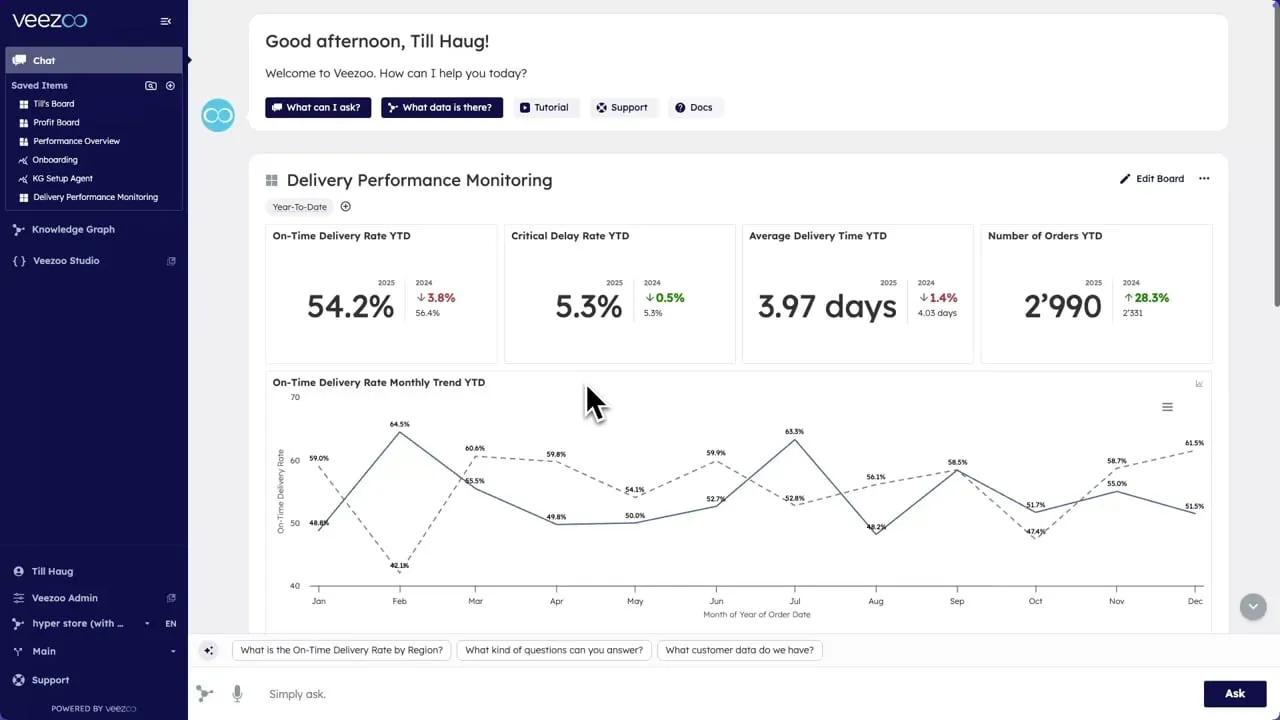
Veezoo turns governed data into scheduled dashboards, recurring business reviews, threshold and natural-language alerts, and AI-detected anomalies, delivered to email, Slack, and Microsoft Teams. Agents run on a schedule, monitor your KPIs, and surface forecast-aware updates so your team can act before issues become incidents.

Built for

Operations teams monitoring exceptions

Finance teams running recurring business reviews

Commercial teams watching performance changes

AI reporting in Veezoo

Veezoo's AI reporting workflow runs governed analytics on a schedule. You set up dashboards, business reviews, or alerts in natural language, and Veezoo delivers them to email, Slack, or Microsoft Teams with summaries and supporting visuals. Alerts can be threshold-based ("revenue dropped below X") or described in plain language ("notify me if something looks unusual").

Outputs
Scheduled dashboards, PDF business reviews, Slack / Teams alerts, email digests, embedded dashboards.
Triggers
Time-based schedules, threshold breaches, AI-detected anomalies, and natural-language conditions.
Inputs
Live queries against your warehouse, no copies of transactional data leave your infrastructure.
Consistency
Agents run on the same governed Knowledge Graph as ad-hoc chat, so report metrics match dashboard metrics.
Context with every alert
Multi-step root-cause analysis is included with notifications, so a triggered alert arrives with the why, not just the what.

Common buying questions answered here

  • AI reporting tool
  • AI alerts for business intelligence
  • automated business reporting
  • AI forecasting and what-if analysis tool

What automated AI reporting actually delivers

Six modes that turn ad-hoc analysis into a reliable, low-noise reporting layer for the business.

Scheduled dashboards

Pick any dashboard, set a cadence (hourly, daily, weekly, custom), and deliver it to email, Slack, or Teams, with row-level security applied per recipient.

Recurring business reviews

Turn structured reviews, monthly business reviews, weekly ops reviews, sales pipeline updates, into agents that compile fresh data, charts, and commentary on every run.

Threshold-based alerts

Define precise conditions: "Alert me when churn exceeds 5%" or "notify me when stock-out rate jumps over 2%." Veezoo fires only when the condition is met.

Natural-language alerts

Describe what to watch for in plain English: "let me know if something looks wrong in last week's sales data." The agent uses Knowledge Graph context to interpret intent.

Anomaly detection

Let the AI identify outliers and unusual patterns without writing explicit rules, useful when the data is too volatile or too segmented to threshold by hand.

Slack, Teams, and email delivery

Notifications arrive in the channels your team already lives in, with the supporting data and visualizations attached, and a link back to the agent run for deeper exploration.

How AI reporting changes the way teams stay informed

Q1

How does AI reporting work in Veezoo?

You build a chat, dashboard, or business review once. Then you save it as an Agent and pick a schedule (hourly, daily, weekly, custom) and a delivery channel.

Each run executes the same governed queries through the Knowledge Graph and packages results with summaries, visuals, and links back into Veezoo for follow-up exploration. Because agents reuse the same semantic definitions as ad-hoc analytics, the numbers in a Monday-morning report are the same numbers a user sees later in chat.


Q2

What's the difference between a scheduled dashboard and an alert?

A scheduled dashboard always delivers, you want a fresh view every Monday morning whether or not anything has changed.

An alert is conditional, Veezoo only pings the recipient when a threshold is breached or an anomaly is detected. Both share the same underlying agent infrastructure, so you can start with a dashboard and add alert conditions to it later as understanding of the data matures.

Q3

How does Veezoo prevent alert fatigue?

Three mechanisms work together. First, alerts only fire when conditions are met, and conditions can be expressed precisely or in natural language.

Second, natural-language alerts let the AI reason about whether a change is meaningful before sending a notification. Third, multi-step root-cause analysis runs when an alert triggers, so the message arrives with context (drivers, segments, contributing factors) rather than just a number.

Q4

Where do reports land?

Email, Slack, and Microsoft Teams are first-class delivery channels with full context: what triggered the alert, the relevant data, the supporting charts, and recommended next steps.

Dashboards can also be embedded in your own product through Veezoo's Embedded Analytics, useful when reports need to reach end customers or partners inside an existing portal.

Q5

Can forecasts and what-if be part of reports?

Yes. Veezoo's analytics surfaces include forecast-aware updates and scenario parameters, so a scheduled business review can show actuals, forecasts, and what-if outcomes against the same governed metrics.

Planning and reporting share the same Knowledge Graph, so the team that builds a forecast and the team that reads a weekly review work from the same definitions.

Trust by construction

Reporting you can take to the leadership team

AI never writes SQL

The AI reasons over business concepts in the Knowledge Graph. SQL is generated by a deterministic compiler, not by the language model.

Every query is traceable

Each answer exposes the intermediate VQL plan and the compiled SQL, so analysts and auditors can inspect exactly what was executed.

Governance you can prove

Knowledge-Graph-level, column-level, and row-level permissions are enforced before any query runs. SOC 2 Type II and GDPR compliant.

Connects live to your warehouse

Native connectors for Snowflake, BigQuery, Databricks, and 14 more. dbt models import directly. No raw data is copied out of your infrastructure.

Snowflake
BigQuery
Databricks
Amazon Redshift
Amazon Athena
PostgreSQL
MySQL
SQL Server
Oracle
ClickHouse
Exasol
SAP HANA
Presto
Trino
Denodo
IBM DB2
Excel
When you want to capture the last percentage of revenue potential of a sales outlet, a standard dashboard is just not enough. We need the flexibility to look at the data and ask questions never asked before. Now I don't need to think if a question is worth asking to the controlling team. I just ask Veezoo.
Monika Zander
Monika Zander
Managing Director Food Service Switzerland, Valora Group

Trusted by data and business teams at

AXA
Bayer
Breitling
BMW
Coop
Dr. Reddy's
Air Up
Baloise
Hahnair
Classic Football Shirts

Frequently asked questions about AI reporting

What's the simplest way to start with AI reporting?

Save any productive chat or dashboard as an Agent, set a schedule, and choose a delivery channel. Most teams start by automating an existing weekly or monthly report that someone is compiling by hand today, then layer in conditional alerts as they learn what really needs attention.

Can the AI generate the report content too?

Yes, Veezoo can produce natural-language summaries of results and "so what" commentary alongside the charts and tables, so a report reads like a briefing instead of a dashboard dump. Chart titles, filters, and labels remain rendered from VQL, not from the LLM, so the descriptive text stays verifiable.

Does Veezoo support PDF business reviews?

Yes, full conversations and dashboards can be exported to PDF for presentations and documentation, and scheduled agents can attach PDFs to email deliveries.

How do alerts integrate with Slack and Microsoft Teams?

Veezoo connects to Slack and Microsoft Teams workspaces using each platform's standard integration model. Recipients receive alerts and scheduled deliveries with full context, and only see data they have permission to see.

What if our KPIs are defined elsewhere (for example, in dbt)?

Veezoo can import dbt models, metrics, and documentation to bootstrap the Knowledge Graph. Once imported, definitions can be evolved in either tool with clear ownership, many customers keep transformation logic in dbt and concept/metric definitions in Veezoo.

Can multiple teams share the same report?

Yes, row-level security ensures each recipient sees only their data. The same dashboard delivered to two regional managers shows different rows depending on each manager's permissions, without maintaining separate reports per team.

Go deeper

Product

Replace the manual Monday-morning report

Set up your first scheduled agent, see results in your inbox or Slack, and free up the hours your team currently spends recompiling the same numbers.