The Veezoo Analytics Cup is live — Submit by May 25 and win a MacBook Pro
Veezoo dashboard creation for self-service BI

Self-service BI that scales without breaking governance.

Veezoo lets non-technical users ask questions, build dashboards, and drill into metrics in natural language. A governed Knowledge Graph defines business concepts, metrics, and access, so analysts stay in control of definitions while everyone else gets answers in seconds.

Built for

Business users who need ad-hoc answers

Analysts reducing repetitive request queues

Data leaders scaling governed analytics adoption

Self-service BI, defined

Self-service BI in Veezoo means anyone, not just analysts, can explore governed data in natural language and build dashboards on top of it. The semantic Knowledge Graph keeps metric definitions and permissions consistent, so a business user gets the same answer an analyst would, and analyst tickets go down instead of up.

Who it's for
Business users in finance, sales, ops, marketing, product, and customer success.
What they can do
Ask questions, build dashboards, drill into metrics, save reusable agents, and share answers with the right people.
Languages
English, German, French, Italian, and Portuguese, including questions about entities in your data.
Safety net
Governed semantic layer, row / column / Knowledge-Graph-level permissions, and a full audit log of every query.
Outcome
Analyst time freed for higher-impact modeling work; faster decisions across the business.

Common buying questions answered here

  • self-service BI with AI
  • natural language dashboard tool
  • AI dashboard tool for business users
  • conversational analytics platform

What real self-service BI looks like in 2026

Self-service is more than a drag-and-drop editor. These are the capabilities that determine whether business users actually use it.

Ask in natural language

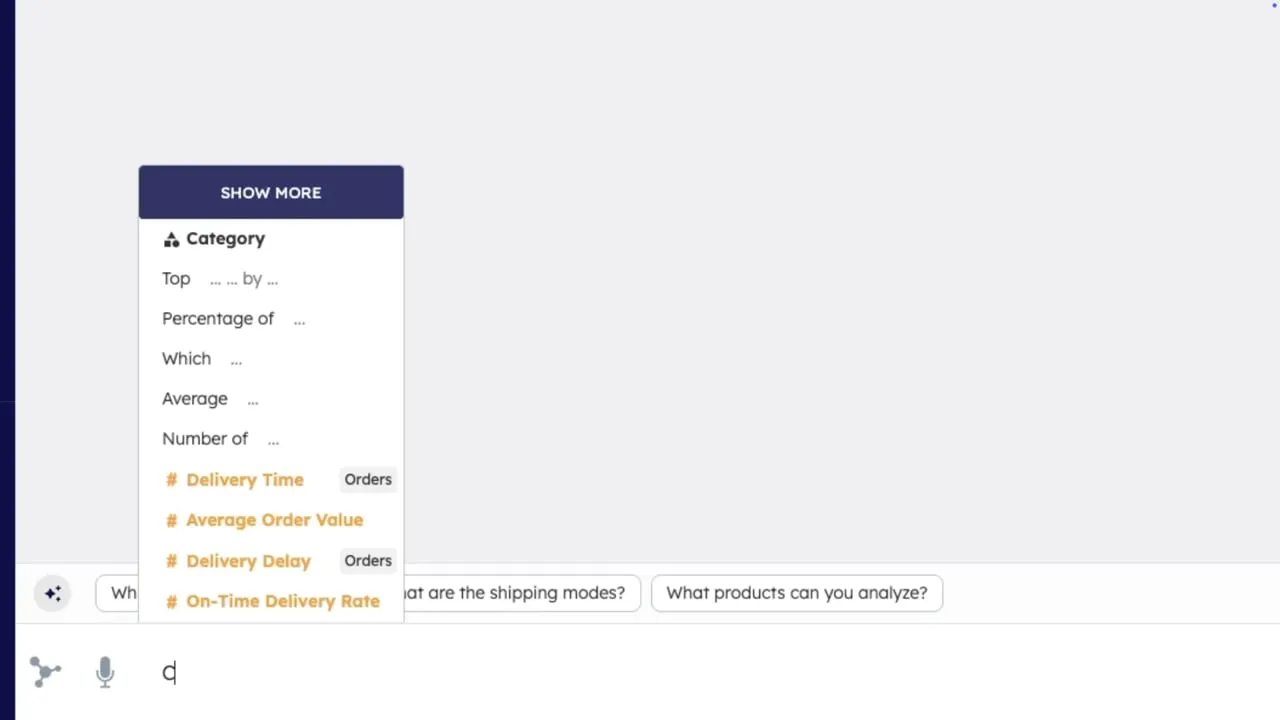
Plain-language questions in five languages. Question suggestions and smart autocomplete make the empty input field less intimidating.

Build your own dashboards

Describe what you want; Veezoo arranges widgets and picks visualizations. Refine, drill in, save, and share with the team.

Drill down conversationally

Follow up on any answer, "split by region", "compare to last year", "why did it drop?", and let the AI keep the context.

Multi-step root-cause analysis

Ask "why?" and Veezoo automatically runs the supporting queries, different dimensions, time-period comparisons, segment-level analysis, instead of leaving users to drill manually.

Multi-language support

Native support for English, German, French, Italian, and Portuguese, and for entity values in those languages.

Governed by the semantic layer

Every question is answered against the Knowledge Graph, so business users see the same metrics the data team defined, with permissions enforced before SQL runs.

How AI self-service BI changes who can use data

Q1

What is self-service BI?

Self-service BI is the practice of letting business users explore data and build their own reports without depending on engineering or analyst teams for every request.

Traditional self-service approaches used drag-and-drop visual editors and required users to understand the data model. AI-native self-service lets users describe what they want in natural language; the system handles the query, layout, and follow-up exploration, and the semantic layer keeps the answers consistent with how the business defines its concepts.


Q2

How do non-technical users build dashboards in Veezoo?

They describe what they want: "Show me sales by region with monthly trends." Veezoo creates a dashboard with relevant widgets, sensible default visualizations, and an editable layout.

From there, users refine ("compare to last year", "make it a heatmap", "add a trend line"), drill into any chart, and save the dashboard for the team. No SQL, no drag-and-drop modeling, but full edit access for the parts the user wants to customize.

Q3

How does the semantic layer keep self-service safe?

The Knowledge Graph defines concepts, metrics, hierarchies, and synonyms once. When a user asks a question, the AI interprets it against those definitions, not against raw column names, so two phrasings of the same question return the same answer.

KPI logic is consistent everywhere; column-level and row-level permissions are enforced before any SQL is executed; and a full audit trail records every query for compliance review.

Q4

Will it replace the data team?

No. Veezoo shifts what the data team does: less ad-hoc reporting, more high-value modeling.

Analysts and engineers maintain the Knowledge Graph (as code in a Git-backed repo, with branches and automated tests), import existing dbt models, and tackle the questions that genuinely need bespoke modeling. The day-to-day "can you pull this number?" requests largely disappear.

Q5

Does it work alongside our existing tools?

Yes. Veezoo can import dbt models, run live queries against your warehouse, deliver insights to Slack, Teams, and email, and embed dashboards into your own product.

Most teams adopt Veezoo for AI self-service while keeping their existing BI investment, then expand its footprint over time as adoption grows.

Trust by construction

Self-service for everyone, control for the data team

AI never writes SQL

The AI reasons over business concepts in the Knowledge Graph. SQL is generated by a deterministic compiler, not by the language model.

Every query is traceable

Each answer exposes the intermediate VQL plan and the compiled SQL, so analysts and auditors can inspect exactly what was executed.

Governance you can prove

Knowledge-Graph-level, column-level, and row-level permissions are enforced before any query runs. SOC 2 Type II and GDPR compliant.

Connects live to your warehouse

Native connectors for Snowflake, BigQuery, Databricks, and 14 more. dbt models import directly. No raw data is copied out of your infrastructure.

Snowflake
BigQuery
Databricks
Amazon Redshift
Amazon Athena
PostgreSQL
MySQL
SQL Server
Oracle
ClickHouse
Exasol
SAP HANA
Presto
Trino
Denodo
IBM DB2
Excel
Thanks to Veezoo's conversational solution, our sales partners can quickly and easily find the answers to their many questions – enabling them to serve their customers even more efficiently and effectively.
Martin Studer
Martin Studer
Head of Distribution Transformation and Controlling, AXA

Trusted by data and business teams at

AXA
Bayer
Breitling
BMW
Coop
Dr. Reddy's
Air Up
Baloise
Hahnair
Classic Football Shirts

Frequently asked questions about self-service BI

How long until business users are productive?

Usually within hours of access. The combination of question suggestions, smart autocomplete, natural-language input, and AI-generated dashboards means most users get to a real answer on day one.

Can users ask follow-up questions?

Yes. Veezoo keeps conversational context, follow-up questions like "now split by region" or "compare to last year" are interpreted relative to the previous answer, just as a person would expect.

How does Veezoo handle ambiguous questions?

The system detects ambiguity (multiple matching concepts, unclear time periods, multiple plausible metrics) and asks a clarifying question or surfaces options inline, instead of guessing and producing a confidently wrong answer.

Can a business user create their own alert?

Yes. Any chat or dashboard can be saved as an agent and scheduled, with delivery to email, Slack, or Microsoft Teams. Threshold conditions and natural-language conditions are both available from the same interface.

Will users see data they shouldn't?

No. Multi-layered governance applies Knowledge-Graph-level, column-level, and row-level permissions to every query, and the AI cannot bypass these layers because it operates only on the Knowledge Graph, not on raw tables.

What stops users from generating bad analyses?

The AI operates only on pre-defined Knowledge Graph concepts, and SQL is compiled deterministically. Chart titles, filters, and labels are rendered from VQL, not generated by the LLM, so users can verify what each chart actually shows.

Go deeper

Product

Put data in the hands of the team that has the questions

Connect a warehouse, auto-generate a Knowledge Graph, and watch business users answer their own questions in natural language.